SOLARIS - The first study on how a total solar eclipse affects the human body · 12 August 2026 SOLARIS - El primer estudio del efecto de un eclipse solar en el cuerpo humano · 12 agosto 2026 ExploreExplora
Home
Our Solution
Our Solution How it works Stroke Impact
About Us
About Us Team
Testimonials News Contact Us
AI-powered Stroke Prevention

Revealing hidden cardioembolic pathologies
before stroke hits

ECG - OneCareAI

OneCareAI applies ECG and molecular biomarkers data with AI and High Performance Computing to silent heart pathologies, preventable causes of cardioembolic stroke.

The hidden risk

Silent heart pathologies: the stroke risk nobody detects

Cardioembolic stroke is caused by silent cardiac conditions: atrial fibrillation, structural heart disease, arrhythmias, that go completely undetected by conventional check-ups. No symptoms. No warning. Until the stroke happens.

30%
of strokes are caused by cardiac conditions
85%
of strokes are isquemic
30%
of isquemic strokes are cardioembolic
1st
cause of disability and 2nd leading cause of death in Europe
How heart pathologies lead to stroke - and how we intercept them
Irregular ECG pattern
Heart pathologies leave brief, subtle signatures in ECG recordings invisible to the human eye.
AI + molecular biomarker analysis
Our models cross-reference ECG signals with genetic and molecular biomarkers to detect hidden cardioembolic risk with high accuracy.
Early clinical alert
The clinical team receives an actionable alert in time to start preventive intervention.
Our Solution

An AI platform that goes beyond conventional ECG

A SaaS platform designed for hospitals that integrates real-time ECG monitoring with genetic, molecular and clinical data, powered by AI and High Performance Computing.

ECG-based cardioembolic risk detection

Continuous analysis of ECG signals from patches, sensors and mobile devices. Our AI detects hidden signature patterns that standard readings miss.

Molecular & genetic biomarkers

We integrate genetic and molecular data with ECG findings - an approach not previously explored in cardioembolic risk detection - to achieve personalised, population-level risk stratification.

Clinical SaaS dashboard

AI-generated personalised stroke risk predictions for each patient, delivered to clinicians in an intuitive dashboard that integrates with existing hospital systems (HIS/EHR).

Population-level screening

Non-invasive risk classification across entire patient populations using ECG devices and molecular data, enabling proactive prevention at scale.

Regulatory & ethical compliance

Developed under EU Medical Device Regulation and the AI Act. GDPR compliant, ISO cybersecurity standards, and CE-mark pathway in progress.

HPC-powered scalability

Built on the supercomputing infrastructure of the Barcelona Supercomputing Center. Our cloud-based AI models train on large datasets and integrate seamlessly into any hospital.

From ECG signal to clinical action

A non-invasive, AI-driven workflow that fits naturally into hospital environments and existing routines.

01

ECG data acquisition

Continuous ECG recordings captured via ECG machines at hospitals, patches, mobile ECG sensors or other non-invasive devices including smartwatches compatible with our platform.

02

Multimodal AI analysis

Our models fuse ECG patterns with genetic, molecular and clinical risk factors, identifying hidden cardioembolic signatures invisible to standard analysis.

03

Personalised risk score

Each patient receives a dynamic, AI-generated stroke risk score that updates continuously as new data comes in.

04

Clinical alert & action

The clinical team is alerted in time to start therapies, preventive interventions before the stroke occurs.

AF Risk Dashboard ● Live
AF Risk Dashboard
Alert: Hidden AF detected in patient - clinical review recommended
Stroke Impact

Numbers that change lives

The scale of the problem and the potential of early cardioembolic risk detection.

1.8M
New strokes in Europe every year and more than 10 million people live with the after-effects of stroke
Source
60B€
Annual economic cost of stroke in Europe in 2017: hospitalisations and long-term care. Future costs could increase to €86B in 2040
Source
80%
Of strokes are preventable with early detection and appropriate treatment
Source
Origin & Partners

Born at the Barcelona Supercomputing Center

OneCareAI is the commercial spin-off of the Innostroke project, developed by the BSC's AI and distributed computing research groups. Validated in collaboration with leading European hospitals.

Barcelona Supercomputing Center (BSC)
Technology development, AI models & HPC infrastructure
Ospedale Niguarda
International pilot - Milan, Italy
Hospital de la Santa Creu i Sant Pau
Clinical validation Proof of Concept, Barcelona
Hospital Universitari de Bellvitge
Clinical pilot testing & scalability validation, Barcelona
Innostroke Ministerio de Transformación Digital NextGenerationEU Funded by the Spanish Ministry of Digital Transformation & NextGenerationEU (ENIA Strategy 2024)

The Innostroke / OneCareAI platform investigates the unexplored potential of molecular biomarkers combined with non-invasive ECG monitoring to enable personalised, population-scale stroke prevention.

Our prototype has already been successfully tested with reference hospitals, and we are now on the path to EU Medical Device regulatory approval and commercial launch as a SaaS platform for hospital networks.

Strategic Partners
Viromii
Business Strategy Consulting
Alira Health
Regulatory Affairs Consulting
Our Team

Balanced and proven team #attitude

Scientists, clinicians and engineers from the Barcelona Supercomputing Center and leading European institutions.

Great team OneCareAI - AI-powered Stroke Prevention
Xavier Guillem
Estefanía Muñoz
Daniele Lezzi
Davide Cirillo

Hover over each face to see who's who

Fatemeh Baghdadi — AI Lead
Simon Lopez — AI Engineer
Omar Briqa — Cloud Engineer
Tomas Arano — IT Developer
Andreu Martin — IT Developer
Testimonials

Collaborations

We have created collaborations with relevant stakeholders in the stroke prevention field.

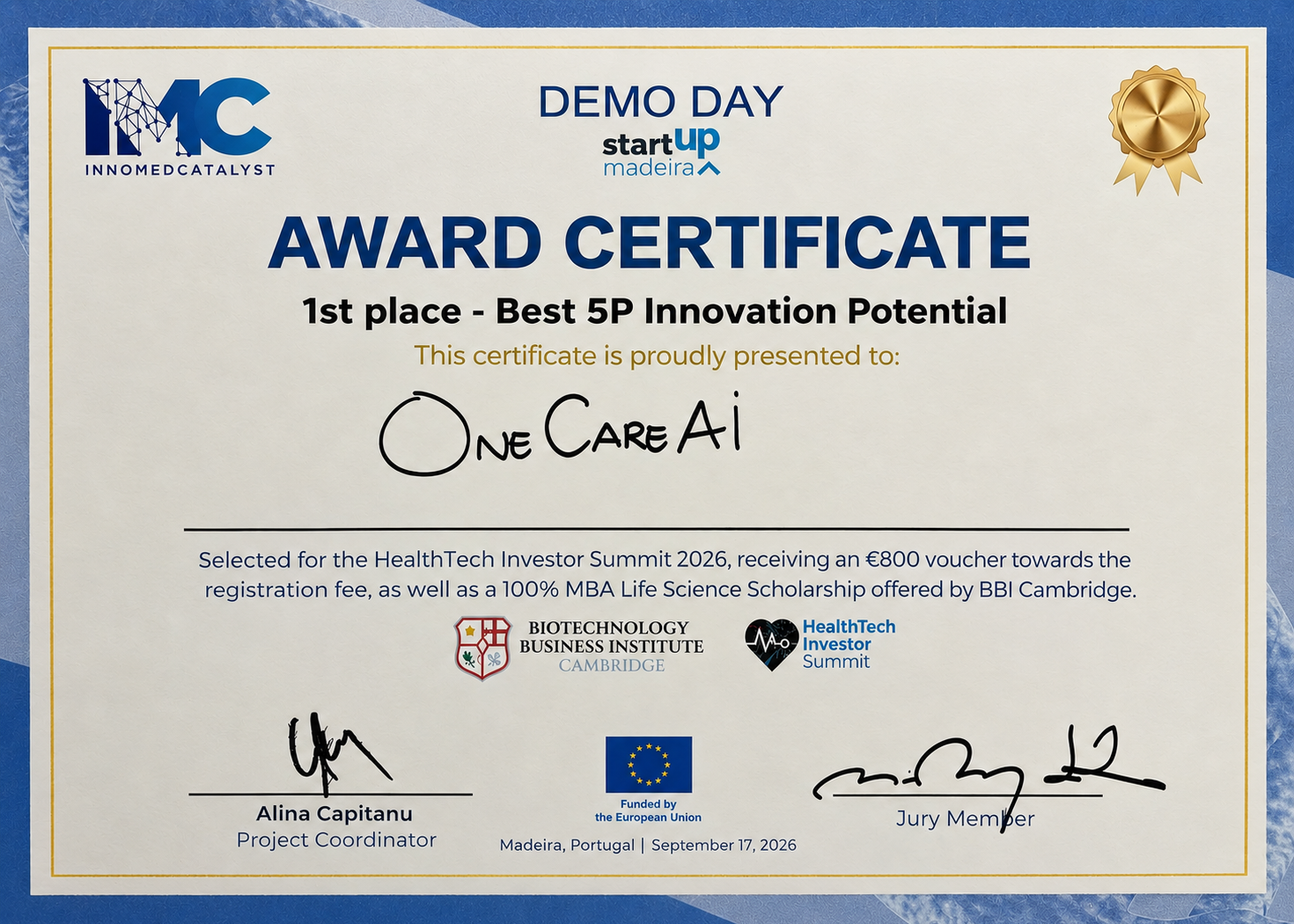
"We are convinced that being able to apply AI-SPRINT study to 2 of our patient populations (one affected by rheumatoid arthritis and one affected by systemic vasculitis) who, due to their rheumatic pathology, present an even greater cardiovascular risk than the general population, could give us relevant results."

Davide Filippini
Neurologist · Niguarda

"Having had the opportunity to collaborate with the Barcelona Supercomputing Center we are highly impressed by the depth of research and innovative approach of OneCareAI. We firmly believe that this project holds great promise for the field of stroke prevention."

Borja Gonzalvez
Product Manager · Nuubo

"The GeneStroke project is a consortium of research groups who share the same interest in elucidating the genetic markers implicated in stroke. It was established in 2008 and is open to groups from all over Spain. We are very keen to collaborate with OneCareAI for the identification of high risk population through AI models."

GeneStroke
Stroke genetics research consortium

"We at Freno al Ictus are very impressed by the outstanding research proposal and the dedication of the Barcelona Supercomputing Center to improve stroke prevention, as well as the interdisciplinary approach proposed, the scientific quality of its members, and the potential of bringing the benefits of edge systems and Artificial Intelligence to stroke healthcare."

Freno al Ictus
Patient foundation · Stroke prevention
News

Latest updates

Stay up to date with the latest developments from OneCareAI and the Innostroke project.

Contact Us

Let's talk about how we can help you

Request a personalised demo for your hospital or clinical team. No commitment required.

Also from OneCareAI
SOLARIS - Your heartbeat
advances science
The first large-scale citizen science study on how a total solar eclipse affects the human body. Over 3,000 people joined with their smartwatch and the SOLARIS app - powered by OneCareAI technology.
Learn more →
Promoted by Generalitat de Catalunya · VHIR · IEEC · Eclipse: 12 August 2026
También de OneCareAI
SOLARIS - Tu latido
avanza la ciencia
El primer estudio de ciencia ciudadana a gran escala sobre cómo un eclipse solar total afecta al cuerpo humano. Más de 3.000 personas participaron en el estudio con su smartwatch y la app SOLARIS - tecnología de OneCareAI.
Saber más →
Promovido por la Generalitat de Catalunya · VHIR · IEEC · Eclipse: 12 de agosto de 2026
Eclipse total SOLARIS